
ch engine optimization: 19 practical tips
It is essential to create content that aligns with the search intent if you want your site to appear in search engine results.
The user’s intent determines the purpose of their search. Search engines are aiming to deliver results that satisfy the user’s intent.
Here are some tips for optimizing your content for search intent.
1. Search intent can be identified
Before you begin optimizing, it’s important to identify the purpose.
You can classify your search queries in one of three categories:
- Navigational Intent : The main goal is to locate a particular website.
- Transactional Intent (also known as commercial intent): The main goal is to buy something. Commercial intent: The primary goal is to purchase something.
- Informational Intent: To learn something.
Semrush, Ahrefs, and Sistrix are all tools that can be used quickly if you work at scale.
They automatically include intent classification in their keyword research to help get things started.
You can see that the intent of the people searching for Barbie products is different from those who are looking to know more about the movie.
These types of search intentions will help you get started on the right foot.
You may find, for example, that you are using a transactional web page to answer a query when it would be better to create or update a rich resource of information.
This is an important first step. It’s much better to know this information before you start optimizing your page than after. You may not think it is as obvious as you would like.
2. Imagine yourself in the shoes of others
You now have a general classification of intent. Try to think as your intended audience.
We all know how to get good results.
If not, can you tell where it’s lacking? Can you tell where the content is lacking?
It’s much easier to plan content when you have a clear idea of what search intent optimization is. Imagine yourself as the user that you are trying to attract.
Review the SERPs
Use a search engine instead of research tools to see what topics are ranking well for the topic that you want to optimize. This is extremely important.
I’ve been pleasantly surprised by the difference between what I believe people are looking for and what actually ranks. We can sometimes be too close with our products or the industries in which we work to see the big picture.
Search results are a good place to start.
- What kind of page is this?
- What does the content look like?
- What is your version?
Search intent may lead you to find that the majority of content that is relevant for your search involves something that you missed, or that it’s formatted differently.
You may not always see the similarities, but you should review the SERPs to find out.
4. Analyze the current results
Check your ranking and click through rate for the query you have chosen. This could be a sign of a problem with search intent.
Look at engagement metrics such as bounce rate, time spent on page and more.
You may not have satisfied the search query as well as possible if people don’t engage with your page.
Compare the metrics of a similar page to yours and use that information to optimize content. You can then identify areas for improvement.
5. Consider mixing intent
Consider your audience when choosing broad keywords.
Take the phrase “comfortable shoe” for example. It is most likely a person who wants to purchase some comfortable shoes. They probably have a few more questions.
This mixed intent is evident in the SERPs. Most of the top pages show products that satisfy a transactional intent, but others provide information that fulfills an informational intent.

You’ll have to decide which intent of the user will be most beneficial. If you run an ecommerce website, for example, you will choose to optimize based on commercial intent, as this is more likely to align your goals.
6. Check for ambiguous intent
Sometimes the user’s intention is unclear.
They haven’t provided enough information to clarify their question.
You can find the following results if you type in “sliding door” into the search box:
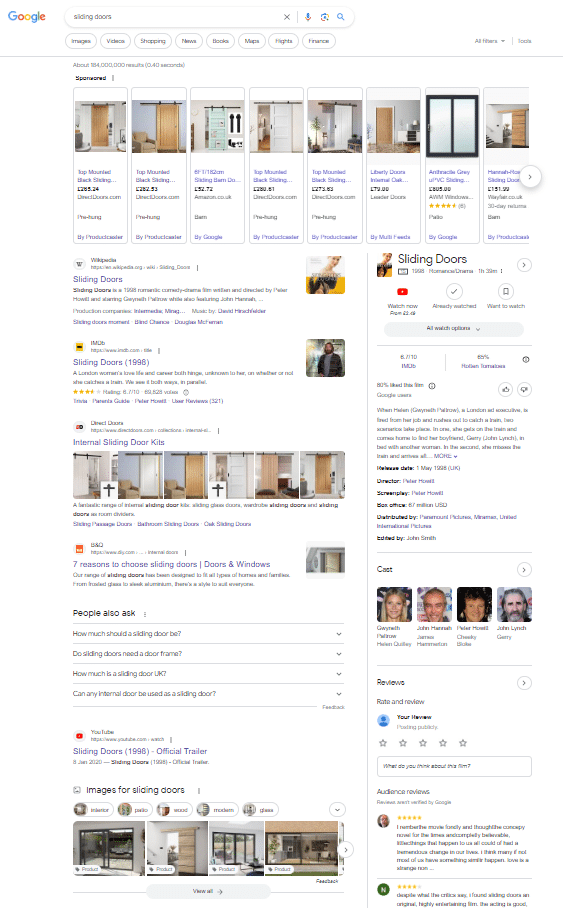
The SERPs reveal:
- Search results for those looking to buy doors.
- Information on the 1998 film.
- Both the product and film are covered by the PAA.
It is confusing. However, it is likely that two people will search with the same phrase but have completely different intentions.
Search engines can’t tell what a person meant, so they provide both results. What should you do if you want to rank?
You can’t alter the mixed results, so you should try to achieve your intended goal.
Even if the results are higher, someone searching for a specific product will not click on them.
Optimize your site to attract traffic by making it relevant to this search intent.
7. Complete the picture with AI
Ask your AI for a list with likely search intentions if you are an in-house or a member of a small team, or if you want to validate or kickstart your ideas.
This simple starter suggested in How to optimize for entities is a great way to get started:
You can ask GPT-4 for a “list of likely search intentions for someone searching Google for running shoes” and get some ideas.
It’s important to ensure that you are not working in silos or ignoring some search intents which may be important for others but not you.
You can use it to optimize your outline so that you cover a wide range of likely micro-intentions. This will create a well-rounded page or piece.
8. Title tags and meta descriptions should be updated to match the intent
The right language used in your title tags and meta description can indicate to the user that the content you provide is relevant to their search intent.
Searchers will be able to see that your site is what they are looking for, and this could increase click-through rates.
Include words such as “buy” and “get” in your query for transactional queries, or “learn” and “discover” for informational queries to make it stand out.
When we search for “how to make a pancake,” top-ranking websites use title tags that include words such as “easy,” “simple,” and “best” or “perfect,” to attract the right audience.
These words can help clarify your search, since some people are looking for simple recipes, while others may be searching for something more complex.
9. Use keyword clusters
When researching keywords for your search query, you should take note of the clustering.
Keyword clustering tools are useful for creating a larger picture of search intent. A single page is rarely ranked for a single query.
The keyword cluster below will help you identify the problem areas that need to be addressed.
If your content does not meet the keyword intent, you may want to add more information about the aluminum options or the problems with the locks.
10. Check out the SERP features
Pay attention to what you see in the SERPs when you do a Google Search. There is a Many people also ask, Knowledge Panel, Image Pack or Local Pack?
These features indicate the intent of the search. These features are there to assist users in finding what they’re looking for, so be sure to pay attention to the options available.
11. Use the SERP features
Can you use the search feature now that you have seen it? What are some of the PAAs that appear in search engine results, for example? Would answering some of these questions improve the search intent for your content?
A visual pack may indicate that you could benefit from adding more visuals to your page. Including your own video could enrich your page if you find a lot of videos.
12. The right format
Formatting helps people to process information and find answers on their own. This is why it’s important when it comes to the search intent.
If the primary goal of a user is to browse through products, then a listing page will best satisfy their intention.
Say we are searching for “dresses to wear at weddings”. We’re probably looking at styles to decide which suits us and what we like.
It’s no surprise that the first results on Google are all product listings pages.
The top search results do not include any other format. The only time this is different is when there are more articles with information at the bottom of the page.
This type of shopper is less likely to be satisfied by a category page that directs users to subcategories such as midi, maxi or mini dresses, rather than listing the products.
It is unlikely that they have yet reached this stage of their decision-making. The micro-intent of the customer is to browse, as they don’t have a clear idea about the type of dress that they want and are looking for inspiration.
13. Include supporting entities
It is easy to match search intent, but it is more difficult to create relevant content that meets the user’s requirements.
Intent and entities go hand in hand. Entities are used by search engines to determine what the content is about, and this content’s meaning confirms that it meets a specific intent.
Understanding the topic and the pain-points of your audience is the best way to show that you understand intent. Create high-quality content with solutions.
You’ll also need to include related entities in your content. This will demonstrate a thorough understanding of the subject.
14. E-E-A-T
You’ll need expertise, trust, authority and experience to really satisfy search intent.
If someone is searching for information about a niche or complex subject, then they are more likely to listen to an expert than a generalist.
These factors can help you optimize your content for search intent. Ask a more knowledgeable person in your organization to review, fact-check or contribute your content.
Ask subject matter experts outside your organization for contributions, quotes or analyses.
15. Check your language
It is beneficial to use the same language throughout your entire copy, just as you would in title tags or meta descriptions.
You can encourage readers to read your content if you show that you are answering their question or meeting their need.
This can be done by adding a phrase that indicates the intention, such as “buy now” or “for sale”, within transactional pages.
You may need to check the readability of your content to ensure that it communicates effectively and clearly. You should consider the words that you use, and whether or not they are in line with your intent. Make sure you address the pain points in a direct and clear manner.
16. Get human feedback
Ask others to review and read your content to ensure that it is in line with the intended purpose.
Does it satisfy their intent? They can suggest improvements.
It’s vital to have a second opinion, because your content is meant for real people. It’s ideal if your target audience can review your page.
If this is not possible, you can ask one or two of your colleagues to look over your content to find areas that need improvement.
17. Receive AI feedback
You could also ask AI to check for intent if you are short on time or have a small group. This is a great way to check your senses and may give you some good optimization ideas.
ChatGPT has added my content to the chatroom.
Create a list that includes the search intents it fulfills. List the intentions in bullet points with the sentiment”.
It’s a good way to check if you are achieving what you intended. You can even ask a simple question like:
Does this copy meet a transactional intention?
Ask follow-up questions in response to the answer. You can use this to help you generate new ideas about how to improve your content.
18. Check your calls to Action
Do you have CTAs that match your intent and include them in the content?
You might choose phrases such as “Learn More” or “Sign Up” for pages that are more informative.
Check if the calls to action support your intent. If necessary, adjust these.
19. Continuously Improve
Search intent, and how search engines understand it, can change.
It’s important to continue to review and improve your top pages, just as you would with any other optimization.
Remember that you are trying to assist users in achieving their goal
You won’t make a mistake when you optimize for search intent if you keep your users in the forefront of all you do.
It is important to note that not all users are the same, and that the intention behind queries can vary, especially when they are broad.
Search engines already use this information and serve the results that best meet the user’s intent.
It is essential that you combine thorough research, both inside and outside of the SERPs. Planning, execution, and feedback to create useful and helpful content.
The first post Search Engine Land : How to optimize your site for search intent. 19 practical tips.