
The Facebook algorithm has a big job. It decides what content billions of people see on their screens every day.
Here’s the really cool part. The algorithm isn’t some unknowable mystery black box. It’s a logical system that rewards authentic conversations, engaging formats, and creators who know how to keep audiences coming back for more. And you can leverage it to get more reach, followers, and customers.
In this guide, you’ll learn how the Facebook algorithm works to rank content on the app. You’ll get tips to improve your reach and see examples from brands that know how to use the algorithm for their benefit. Let’s get growing!
Contents
- What is the Facebook algorithm?
- How does the Facebook algorithm work?
- Facebook algorithm updates and trends to know about
- 10 ways to work with the Facebook algorithm
- Facebook algorithm FAQs
What is the Facebook algorithm?
The Facebook algorithm is a system that combines artificial intelligence and rules-based decision-making to determine which content users see when they scroll through their feed. The algorithm creates a personalized experience, attempting to expose the posts, Reels, and Stories each user is most likely to engage with.
The Facebook algorithm seeks to share content that its users will engage with, like this tutorial on fixing a sink that has over 5,000 likes.
The complex algorithm evaluates thousands of signals, including previous user interactions, content type, content publishers, and previous engagements, to set its recommendations.
It’s helpful to remember that, above all else, Facebook prioritizes increasing user engagement. So as its algorithm evolves, it’s mostly done to serve that goal.
 How much should your Facebook ads cost? Download The 2025 Facebook Ads Benchmarks Report to find out.
How does the Facebook algorithm work?
The Facebook algorithm works by ranking all possible posts you could potentially see and predicting which ones you’re most likely to find meaningful or engaging. It gathers signals and uses predictive models to rank content in your feed.
Every time you open the app, the algorithm has to answer:
- What content can it show?
- What does it know about the post?
- How relevant will it be to the user?
Let’s look at how the Facebook algorithm answers these questions.
The four steps of ranking content
The algorithm uses a four-step process to fill your screen with unskippable images, text, and videos:
- Review the inventory: Facebook collects and reviews the set of posts shared by your friends and from the pages you follow.
- Consider the signals: Then, the algorithm considers hundreds of thousands of signals from the available inventory of posts. It looks at things you’d expect, like who posted the content and when it was posted, as well as more subtle signals like what time it is now and how fast the internet connection is.
- Predict how the content will be received: Here’s where the magic of Facebook’s over 100 prediction models comes in. They assess all the information from the first two steps to make an educated guess at how likely you are to do things like watch a video to completion, comment on a Story, and so on.
- Apply a relevancy score: Finally, the algorithm gives every piece of available content a score based on how relevant it is to you. The highest-scoring content lands in your feed first.

Great content, relevant to your audience, will make its way through Facebook’s selection process.
Recommended vs. connected content
The Facebook algorithm serves up two types of content: connected and recommended. The system strives to show you a mix of both, and there are nuances to how each is ranked.
- Connected content: These are posts from friends, accounts you’re following, and groups you’ve joined. Most of the posts you see fall in this category, and it’s chosen based on how you’re connected to the publisher and how you’ve interacted with similar content.
- Recommended content: This includes posts published by accounts you aren’t friends with or following, but that may have some relevance to you. Facebook recommends this content based on how you’ve interacted with similar content from similar publishers.
Facebook content standards
You can’t discuss the Facebook algorithm without mentioning the platform’s two sets of content standards. If you run afoul of these rules, no amount of relevance or connection will get your post past the algorithm’s filters.
Facebook’s Community Standards are rules about what people can and can’t share on the platform. They cover areas like:
- Violence and criminal behavior: Threats, terrorism, organized crime, and the like.
- Safety: Think bullying, harassment, suicide, or self-injury content.
- Objectionable content: Includes hate speech, adult nudity, and sexual exploitation.
- Integrity and authenticity: This covers misinformation, fake accounts, spam, etc.
- Respecting intellectual property: Things like copyright and trademark rights are covered here.
Recommendation Guidelines are the rules that govern what content Facebook will not suggest to users in areas like Groups, Pages, Marketplace, or the main feed. Even if a post doesn’t break Community Standards, it may still be downranked or excluded from recommendations if it could create a poor or unsafe experience.
These guidelines restrict things like:
- Borderline content: Sensational, misleading, or low-quality posts.
- Sensitive topics: Health claims, political or civic content, and unverified information.
- Potentially unsafe or inappropriate material: Violence, sexually suggestive content, and spammy links.
The Facebook algorithm vs. other social media algorithms
Another way to contextualize how the Facebook algorithm works is to compare it to other popular social media sites. Here’s a quick rundown of their key differences:
- Facebook algorithm: It prioritizes meaningful interactions between friends, family, and groups. Its ranking factors lean heavily on relationship strength, type of content, engagement, and recency.
- TikTok algorithm: The TikTok algorithm focuses on the discovery of new-to-you creators through its For You Page (FYP). Ranking factors center around previous interactions (watch times, likes, etc.), video information, and your device and account settings.
- Instagram algorithm: Instagram’s algorithm takes a blended approach that balances both personal connections and trending, engaging content. Its ranking factors rely on relationship history, engagement signals, and relevance to your interests, among others.
- X (formerly Twitter) algorithm: Real-time conversations and trending topics are at the forefront of what X’s algorithm shares most. It ranks content heavily on recency, engagement, and personalization to the user.

Giveaways like this one are a great way to juice the Facebook algorithm with engagement.
User controls
Even though the algorithm is always working in the background to order the content on your feed, you have considerable control over what it chooses to show you. Here are several of the most prominent user controls you can apply to influence the algo:
- Favorites: You can mark certain friends or Pages as Favorites so their posts appear higher in your feed.
- Snooze: Temporarily hide posts from a person, Page, or Group for 30 days without unfriending or leaving.
- Unfollow: Stop seeing posts from someone entirely while still staying connected.
- Hide Post/See Fewer Like This: Tell the algorithm you don’t want to see similar content in the future.
- Feed Preferences: A settings hub where you can manage Favorites, Snooze, Unfollows, and reconnect with people/Pages to shape your feed experience.
Facebook algorithm updates and trends to know about
If there’s one thing constant about Facebook’s algorithm, it’s change. Here are some trends to be conscious of as you post throughout 2025 and beyond.
Prioritizing Reels
Starting around 2023, Facebook began increasing the weight given to short-form video content. They started pushing Reels into feeds and recommendations. This was likely a response to the popularity of TikTok.
For brands, that means it’s time to experiment with some quirky, little, fun, and educational videos if you want to expand your Facebook reach.

Even dentists can have some fun with Facebook Reels.
AI-driven content recommendations
Given Mark Zuckerberg’s big AI push, it’s no surprise that Meta rolled out more AI-powered suggestions in the Feed, surfacing posts from outside your friend network if they’re predicted to be relevant.
Hyper-relevance for your target audience is the name of the game here. Learn their vernacular and pay attention to the content they react to. Use that insight to publish posts they’ll like and share.
Clickbait and engagement bait downranking
Meta is explicitly targeting obviously spammy content and taking steps to lower its reach. That either means penalizing their content in the rankings or removing accounts that coordinate fake engagement posts.

It’s a good time to steer clear of spammy tactics. If you’re not sure whether what you’re about to publish is clickbait, ask yourself, “Will this genuinely help my target audience, or am I posting this strictly for engagement?”
10 ways to work with the Facebook algorithm (with examples)
Now that we understand how the Facebook algorithm prioritizes content, let’s look at 10 ways you can work with it to give your Facebook marketing a big boost.

1. Spark real conversations
While this list of tips isn’t in any specific order, this one is probably the most important of the bunch. Facebook’s algorithm prioritizes engagement. Make sure some of your posts ask questions, start conversations, and poll people for their opinions.

Bonus: Want a fast and free focus group? Share a few options of a new product or design and see what your followers prefer (plus juice the algorithm with all that engagement!).
2. Post consistently, not constantly
While content recency is a Facebook ranking factor, you don’t want to overwhelm your audience. So create a consistent publishing calendar so the algorithm has something new to share, but avoid over-publishing so it looks like you’re spamming.
There’s no hard and fast rule about how often to post on Facebook. Instead, think about your audience and plan seasonally. If you sell sunscreen, ramp up posts at the beginning of summer.
 Not sure what to post? Get Your Copy & Paste Social Media Calendar for a year’s worth of content ideas.
3. Lean into video and Reels
Facebook is boosting short-form, native, and live video in feeds, so now’s a good time to publish that type of content, especially on Facebook Reels.
Beauty brand ColourPop regularly posts popular videos in a variety of formats.

Copy the brand’s strategy by posting some quick tutorials and product videos. Or try a funny “Day in the Life” clip to show what it’s like behind the scenes at your business.
4. Write scroll-stopping intro hooks
Facebook truncates long captions. To stop those thumbs from scrolling past your content (and showing the algorithm it’s worth promoting), put something thought-provoking and provocative in the first lines of your post.
Check out this post from the beverage brand Innocent.

Readers will see the first three items and want to click for the rest of the list. The top comment is the icing on the engagement cake, as it lets you know there is some really good content further down the post.
5. Mix up your formats
Variety is the spice of life. Keep your feed fresh by posting text, videos, images, and carousels. Not only will you give your audience something new to view, you’ll be able to test which content types work best.
For a little inspiration, scroll through Hype’s Facebook account.

You’ll see some shoppable posts, image collages, Reels, and other content types. It gives people a reason to spend more time rummaging around the brand’s Facebook page.
6. Reply fast and often
We’ve established that the algorithm loves to share content that gets comments. You can quickly amplify the discussions on your posts by simply replying when someone comments.
Look at how this physical therapy office nearly doubled the number of comments in its post by continuing the conversation.
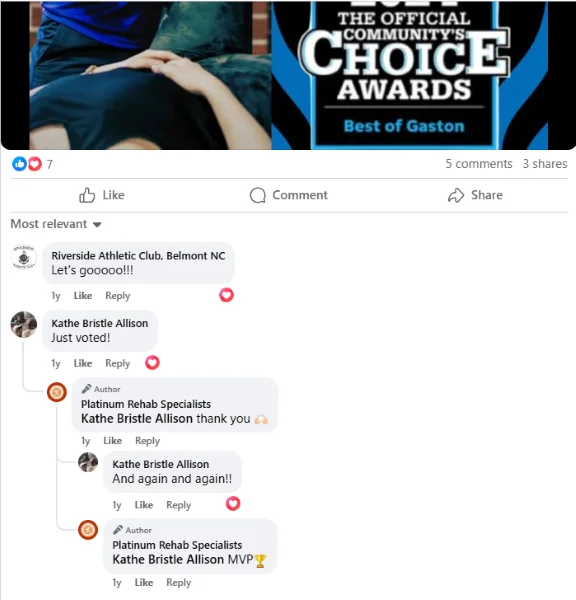
Engagement with your followers like this will also help you build trust, a key factor when they decide who to buy from.
7. Avoid clickbait content
Social media users have become savvy to the trick some less-scrupulous businesses use to generate inauthentic engagement.
Facebook’s algorithm has too. If you try to fudge your way into people’s feeds, the system will flag your content as engagement bait and throttle your chances of greater placement.
Here are several ways to keep your content from being tagged as clickbait:
- Deliver what your post promises: If you say you’ll share four unique, unheard of ideas, don’t just list things everyone already knows.
- Avoid clickbait titles: Don’t use captions like “You won’t believe what happened next!” or “#5 will shock you!”
- Stay consistent with your brand: Don’t post about a topic just because it’s popular if it has nothing to do with your business or typical content.
- Don’t beg for reactions: Stay away from copy like “Like if you love pizza.”
8. Post at the right time
Get a little early engagement boost by posting content when your audience is most likely to be online.
If you look at studies into the best time to post on Facebook, you’ll see they mostly don’t agree.
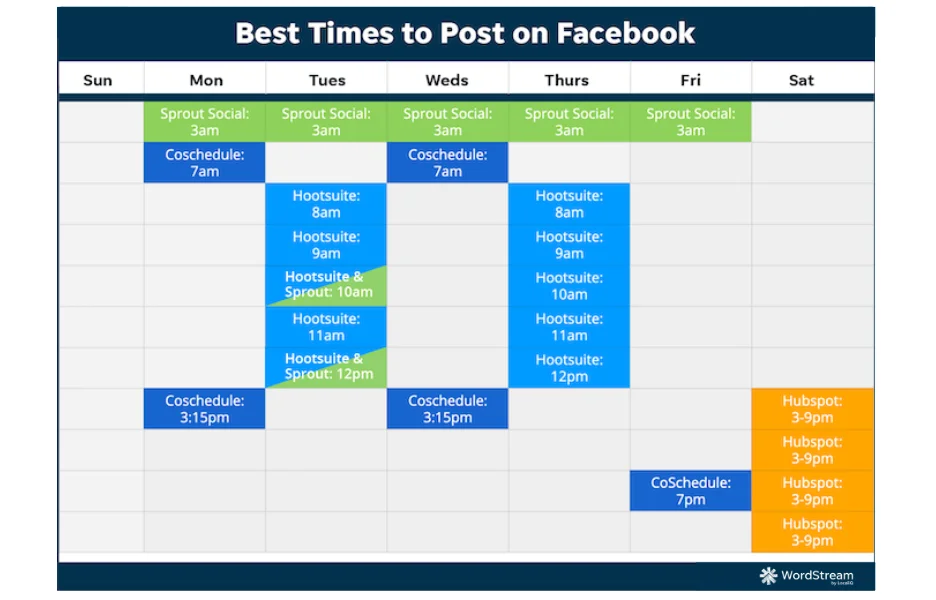
Your best bet is to take an educated guess based on your audience, then home in on it through trial and error.
For example, if you want to reach professionals in their 30s, you might post after the typical workday. But if your audience is active retirees, you could try a little earlier in the day.
9. Be active in groups
Content shared in Facebook groups gets prioritized in feeds because it’s considered meaningful interactions with people you’re connected to. As a brand, you can leverage this ranking factor by becoming a regular participant in a relevant Facebook group.
Sometimes, customers will create a Facebook group to talk about your brand. That’s what happened for this travel trailer manufacturer.

But even if that hasn’t happened, you can look for groups that tie into what you sell. For example, this brand could search for camping, travel trailer, or off-road adventure communities.
A word of caution. Don’t be overly salesy on any online forum. Go in to be helpful, answer questions, and participate. Your educational posts will get an algorithm boost and you’ll grow an engaged, targeted audience.
10. Track your analytics
Facebook offers a robust dashboard of analytics you can track that’ll help you understand how the algorithm works for your brand.
For example, you can see which content type gets the most views and engagements. Then, use that data to inform your next campaign.
All this data will tell you when, what, and where to share on Facebook for maximum reach.
Facebook algorithm FAQs
We’ve covered a lot of ground. Here are some of the most frequently asked questions about the Facebook algorithm.
How does the Facebook algorithm decide what I see?
To decide which posts end up in your feed, Facebook looks at who posted, the type of content, how likely you are to interact, and how recent it is.
How often does the Facebook algorithm change?
Constantly. Meta makes small tweaks to its algorithms all the time, with major updates a few times a year.
How can businesses beat the Facebook algorithm?
You can’t “beat” the Facebook algorithm, and you shouldn’t try. Instead, work with the algorithm by posting a variety of engaging, high-quality content that your audience will find educational and entertaining.
How can I reset my Facebook algorithm?
You can’t fully reset your Facebook algorithm, but you can influence it by adjusting your feed settings like prioritizing friends, unfollowing pages, hitting the “Snooze” button on content you don’t want to see, and so on.
Is the Facebook algorithm the same as Instagram’s?
Facebook and Instagram’s algorithms are similar, but not identical. Both emphasize engagement, but Instagram relies more heavily on visual discovery and trending audio.
What’s the best time to post on Facebook?
The best time to post on Facebook depends on when your audience is most active on the platform, which you can find in your Facebook analytics dashboard and by tracking your content success.
Learn how the Facebook algorithm works
Too often, social media algorithms are portrayed as some type of sophisticated lock that needs to be bested for success. You’ll do a lot better if you think of it like a suggestion engine you need to work with instead of against.
Remember that the algorithm’s biggest priority is fostering engagement. Let that knowledge guide what you post and when. Publish content that gets people commenting and sharing. And don’t hesitate to jump into the conversation.
The post How the Facebook Algorithm Works in 2025 (+Tips for More Reach) appeared first on WordStream.